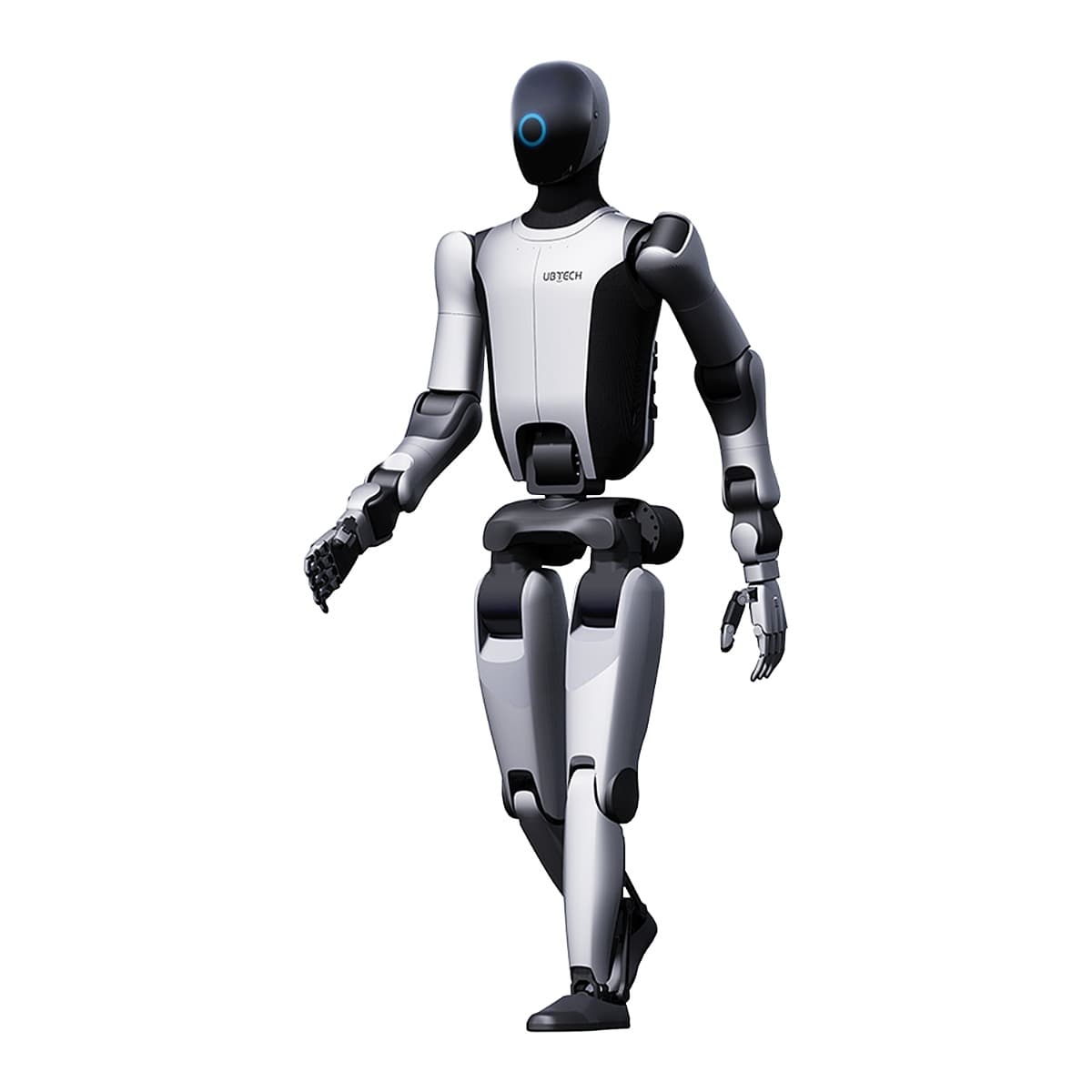
History
UBTECH's rapid evolution from startup to publicly-traded industry leader demonstrates the "Shenzhen speed" advantage in hardware iteration and commercialization.
- 2008-2012: Zhou Jian spends years in "stealth mode" developing proprietary servo actuators, liquidating personal assets to fund R&D and break the monopoly of Japanese and European manufacturers
- March 2012: UBTECH Robotics formally established in Shenzhen, China
- 2014: Alpha Robot released—China's first commercialized small-sized humanoid robot, generating critical early cash flow
- 2015: International branding campaign launches with UBTECH appearance in Times Square, New York
- 2016: Watershed cultural moment at China's Spring Festival Gala featuring 540 synchronized Alpha 1S robots performing a dance routine, broadcast to hundreds of millions of viewers
- 2017: UBTECH exhibits at IFA Berlin, entering the European consumer electronics market
- 2018: Achieves Guinness World Record in Italy for largest simultaneous robot dance (1,372 robots). Tencent leads massive Series C funding round valuing UBTECH at $5 billion—the largest funding round for a robotics company globally at the time, achieving "unicorn" status
- 2019: Walker robot (with arms) debuts at CES 2019, demonstrating object grasping and manipulation capabilities, marking transition from consumer entertainment to utility robotics
- 2020: COVID-19 pandemic accelerates service robotics; UBTECH deploys anti-epidemic robots (AIMBOT, Cruzr) to hospitals and public spaces in Shenzhen for temperature monitoring and disinfection
- 2021-2022: Strategic pivot toward B2B industrial applications; delivers hundreds of educational Walker units to South Korean institutions, diversifying revenue base
- August 2023: Strategic agreement signed with Audi-FAW to integrate humanoids into automotive smart manufacturing—the signal that UBTECH was transitioning from service to heavy industry
- December 29, 2023: Historic IPO on Hong Kong Stock Exchange (HKSE: 9880), raising HK$1.015 billion (~$130M USD), becoming the first humanoid robotics company to achieve public listing
- 2024: Introduction of Walker S1 specifically tailored for automotive assembly lines. Pilot programs launched with Nio, Zeekr, and Dongfeng Liuzhou Motor
- August 2024 - February 2025: Four rounds of H-share placements raise additional HK$2.068 billion (~$265M USD), nearly double the IPO proceeds, demonstrating strong institutional investor appetite
- October 2024: Walker S1 deployed for production tasks at Audi-FAW's Changchun EV plant and Zeekr's Ningbo smart factory
- July 2025: Walker S2 unveiled as the world's first humanoid robot with autonomous battery swapping capability, enabling 24/7 continuous operation
- Late 2025: Walker S2 begins mass production and delivery with order backlog exceeding 800 million Yuan (~$110M USD), signaling successful transition from prototype to industrial scaling
Full-Stack Technological Sovereignty
UBTECH's competitive moat is built on vertical integration across the entire technology stack, holding over 2,450 patents (approximately 60% invention patents) as of 2024.
Proprietary Servo Actuators: In traditional robotics, high-performance servo motors and harmonic drives (gear reducers) from Japanese and European suppliers can account for 40-50% of a robot's bill of materials. UBTECH manufactures these components in-house, producing servos ranging from 0.2Nm (consumer robots) to 120Nm+ (Walker legs). This vertical integration dramatically reduces costs while ensuring supply chain independence—critical given potential geopolitical trade restrictions.
ROSA Operating System: The Robot Operating System Application Framework (ROSA) serves as middleware decoupling hardware from software, providing standardized APIs for vision, voice, and motion control. This enables third-party developers to create applications without understanding low-level servo firmware, establishing UBTECH as a platform provider rather than just a hardware vendor.
BrainNet Swarm Intelligence: The BrainNet 2.0 framework enables multiple humanoids to collaborate on complex tasks. For example, multiple Walker S1 units can coordinate to lift heavy vehicle components exceeding individual payload limits, or synchronize inspection routines across multiple assembly stations.
DeepSeek AI Integration: UBTECH integrates the DeepSeek-R1 reasoning model for General Task Planning. Instead of hard-coding every movement, operators can issue high-level natural language commands (e.g., "Inspect the left door for defects"), which the LLM decomposes into motor control sequences adapted to real-time environmental conditions.
Semantic VSLAM: UBTECH's Visual Simultaneous Localization and Mapping system adds semantic understanding beyond traditional geometric mapping, identifying object categories (e.g., distinguishing "conveyor belt" from "wall"). This "two-stage semantic navigation" enables operation in dynamic factory environments where equipment moves frequently.
Automotive Manufacturing Focus
UBTECH has strategically identified automotive manufacturing as its "beachhead market." The sector offers structured environments, high labor costs, acute labor shortages, and a desperate need for quality consistency—ideal conditions for early-stage humanoid deployment.
The "Switzerland" Strategy: Unlike competitors with exclusive partnerships, UBTECH simultaneously collaborates with multiple competing vehicle manufacturers (Audi-FAW, Nio, Zeekr, BYD). This approach provides diverse training data across different production environments while avoiding dependency on any single customer's fortunes.
Brownfield Advantage: A critical insight from deployments is UBTECH's ability to integrate into brownfield (existing) factories. Traditional automation requires factories built around the robot; UBTECH's humanoids operate in spaces designed for humans. At Lynk & Co (Geely), robots worked within existing warehouse aisles, cutting processing time by 40% without facility redesign. At Zeekr, deployment reportedly achieved 60% labor cost reduction.
Pilot-to-Production Model: UBTECH's deployment strategy begins with 3-6 month pilot programs validating specific use cases (quality inspection, component installation, logistics). Upon meeting ROI targets, customers typically expand to multi-unit deployments. The Walker S2's 800+ million Yuan order backlog suggests this model is successfully converting pilots to production contracts.
Financial Performance and Growth Trajectory
FY2024 Financial Snapshot:
- Revenue: RMB 1.305 billion (~$181M USD), representing 23.7% year-over-year growth
- Net Loss: RMB 1.16 billion (~$161M USD), narrowed from RMB 1.265 billion in 2023
- Gross Margin: 28.7% (down from 31.5% in 2023, reflecting strategic pricing for market share capture)
- R&D Intensity: R&D expenses accounted for 46.7% of H1 2024 revenue, confirming UBTECH remains a technology development company rather than mature manufacturer
The "narrowing loss" narrative is critical for investor confidence—revenue growth is beginning to outpace fixed cost growth, suggesting a path toward eventual profitability through manufacturing scale. The gross margin compression reflects a deliberate "land grab" strategy where introductory pricing secures pilot deployments at leading manufacturers.
Capital Structure: The successful raise of HK$2.068 billion following the IPO demonstrates institutional confidence that UBTECH will emerge as the "Foxconn of Humanoids." Backing from Tencent provides strategic value beyond capital, offering potential integration with Tencent's vast AI and cloud infrastructure. State-linked investment vehicles signal implicit government support under China's "New Productive Forces" initiative.
Workforce and Operations
As of December 31, 2024, UBTECH employs 2,191 full-time employees across R&D, manufacturing, and commercial operations. The company operates from its headquarters at the Nanshan IT Park in Shenzhen, with dedicated manufacturing facilities including a 30,000 units/year Cruzr robot production line in Kunming.
The Shenzhen location provides unique access to the world's most efficient electronics supply chain, enabling the rapid hardware iteration cycles that took UBTECH from Walker S (early 2024) to S1 (October 2024) to S2 (July 2025) in just 18 months—a pace resembling consumer electronics rather than heavy industrial equipment.