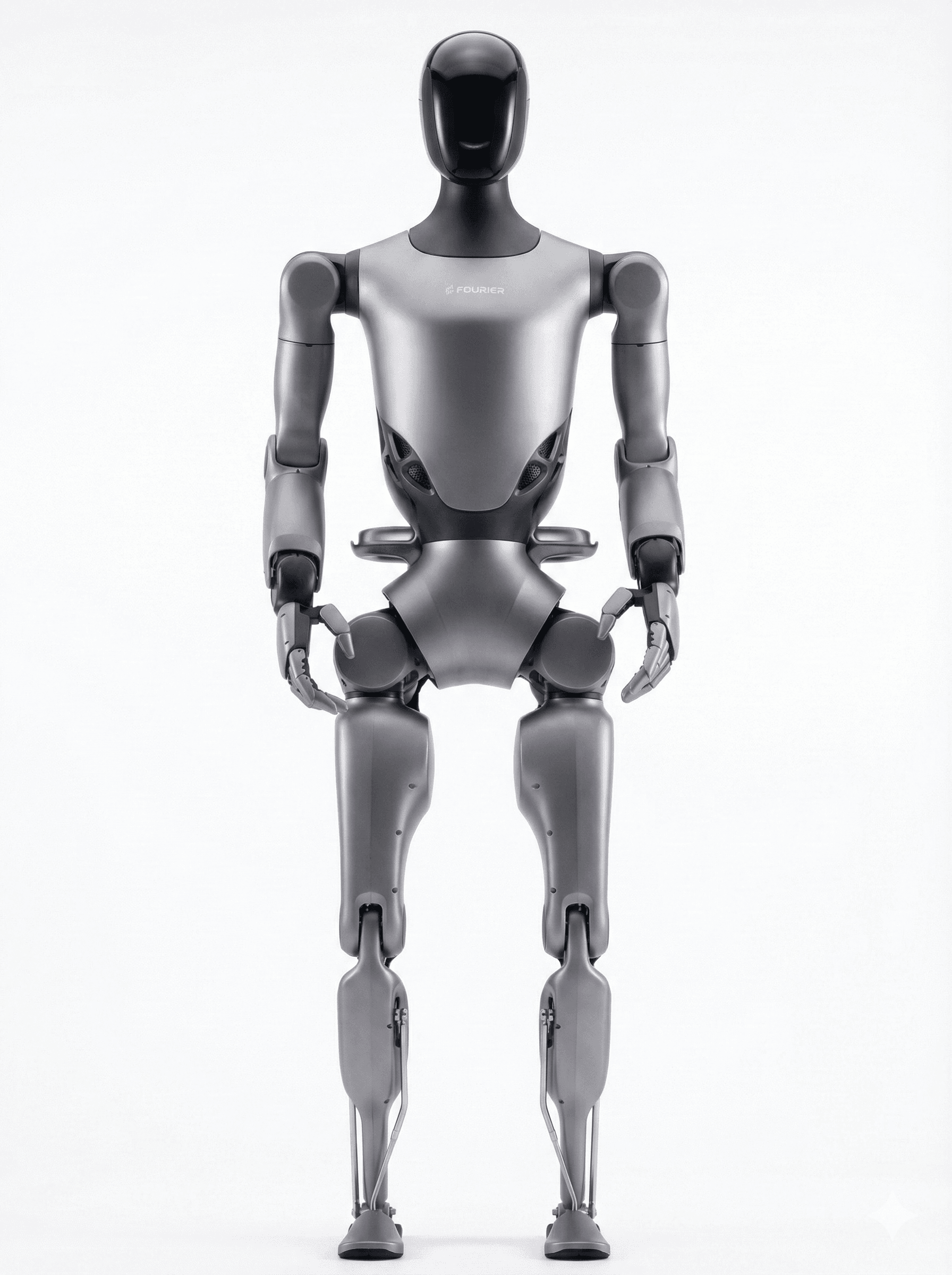
The Fourier GR-2 is the next-generation general-purpose humanoid robot launched in September 2024 by Fourier Intelligence. Building on the success of the GR-1, GR-2 represents a significant leap forward with 53 degrees of freedom, enhanced dexterity, and improved performance capabilities designed for research institutions and industrial applications.
Design Philosophy: Enhanced Human-Like Capability
GR-2's design focuses on increased articulation and dexterity while maintaining practical reliability. At 175 cm tall—10 cm taller than GR-1—the robot better matches average adult human height, enabling even more natural interaction with environments and tools designed for people. The increased height, combined with expanded degrees of freedom, provides GR-2 with a broader reach and more nuanced movement capabilities.
The engineering philosophy emphasizes modularity and upgradeability. GR-2 features seven distinct actuator types optimized for different joints, with high-torque units in load-bearing joints and faster, lighter actuators for fine manipulation. This tailored approach maximizes performance while maintaining efficiency.
FSA 2.0 Actuators: Next-Generation Power
The Fourier Smart Actuators 2.0 (FSA 2.0) represent a significant advancement over the original design. These series elastic actuators integrate motor, controller, gearbox, and dual encoders into compact modules that deliver up to 380 N·m of peak torque—a 65% increase over GR-1's 230 N·m.
The series elasticity provides natural compliance and shock absorption, crucial for safe human-robot interaction. When GR-2 encounters unexpected resistance, the elastic element deflects while sensors detect the discrepancy, allowing intelligent responses like backing off or adjusting force. The dual-encoder feedback system (23-bit on legs, 24-bit on arms) provides exceptional position accuracy of ±0.1°, enabling precise manipulation and stable locomotion.
12-DOF Dexterous Hands: True Five-Finger Capability
GR-2's hands are engineering marvels with 12 degrees of freedom per hand—double the 6 DOF of GR-1. This advanced articulation approaches true human-level dexterity. Each finger features multiple independently controlled joints, with an opposable thumb enabling precision and power grasps.
Six array-type tactile sensor arrays per hand (likely in fingertips and palm) provide detailed force and texture feedback. These sensors enable GR-2 to identify objects by touch, adjust grip pressure in real-time, and handle delicate items without crushing them. The hands can perform complex tasks like turning keys, typing, manipulating small components, or carefully handling fragile objects—capabilities far beyond most robotic manipulators.
Advanced AI and Autonomy
GR-2 achieves semi-autonomous operation through sophisticated AI systems. It uses stereo RGB cameras for vision-based SLAM (Simultaneous Localization and Mapping), creating real-time 3D maps of environments for navigation and obstacle avoidance. An optional 275 TOPS AI accelerator module (likely NVIDIA Jetson AGX Orin) provides powerful onboard inference for computer vision, object recognition, and autonomous behaviors.
Fourier trained GR-2's control policies using NVIDIA Isaac Gym, employing reinforcement learning for complex maneuvers. For example, the floor-to-stand capability achieved an 89% success rate after simulation-based training. This AI-driven approach allows GR-2 to learn new skills through training rather than manual programming.
The robot supports multiple operation modes: fully autonomous task execution, VR-based teleoperation (compatible with Pico headsets and Apple Vision Pro), and lead-through teaching where users physically guide movements that the robot records and reproduces.
Swappable Battery System: Extended Operation
A major improvement over GR-1 is the hot-swappable 950 Wh battery providing approximately 2 hours of runtime—double GR-1's capacity and duration. The quick-release mechanism enables continuous operation by swapping depleted batteries with charged ones, minimizing downtime. The battery charges in about 2 hours using the included charger (90-260V AC universal input), facilitating rotation between battery packs.
Real-World Applications
Research & Development: Universities and research institutions use GR-2 as an advanced platform for studying bipedal locomotion, manipulation, and human-robot interaction. The comprehensive SDK, ROS support, and simulation integration (Isaac Lab, MuJoCo) make it ideal for algorithm development.
Industrial Automation: With 3 kg per-arm payload capacity and 380 N·m joint torque, GR-2 handles light manufacturing tasks, quality inspection, material handling, and tool operation. Its dexterity enables assembly work requiring fine motor skills.
Healthcare & Assistance: The robot's gentle touch control and human-like movement make it suitable for patient care research, rehabilitation assistance, and eldercare pilot programs where safe physical interaction is paramount.
Security & Inspection: GR-2 can patrol facilities, navigate stairs and uneven terrain, manipulate doors and switches, and perform visual inspections in areas challenging for wheeled robots.
Developer-Friendly Platform
Fourier prioritizes developer experience with the Fourier Toolkit SDK providing C++ and Python APIs for high-level control. Pre-optimized modules for machine vision, path planning, and force feedback control accelerate development. Full ROS compatibility enables integration with existing robotics workflows and community algorithms.
The platform supports simulation via NVIDIA Isaac Lab and MuJoCo, allowing safe testing before hardware deployment. SSH access to the Ubuntu 20.04 system provides full control for custom software installation and configuration.
History
GR-2 represents the evolution of Fourier's humanoid robotics platform:
- September 2024: GR-2 officially launched at major robotics conferences, showcasing enhanced capabilities
- Late 2024: Initial units delivered to research institutions and enterprise partners
- Ongoing: Continuous software updates improving manipulation, navigation, and AI capabilities based on deployment feedback
GR-2 builds directly on GR-1's foundation while addressing key limitations: increased DOF for better dexterity, swappable batteries for extended operation, more powerful actuators for demanding tasks, and enhanced developer tools for faster application development.