
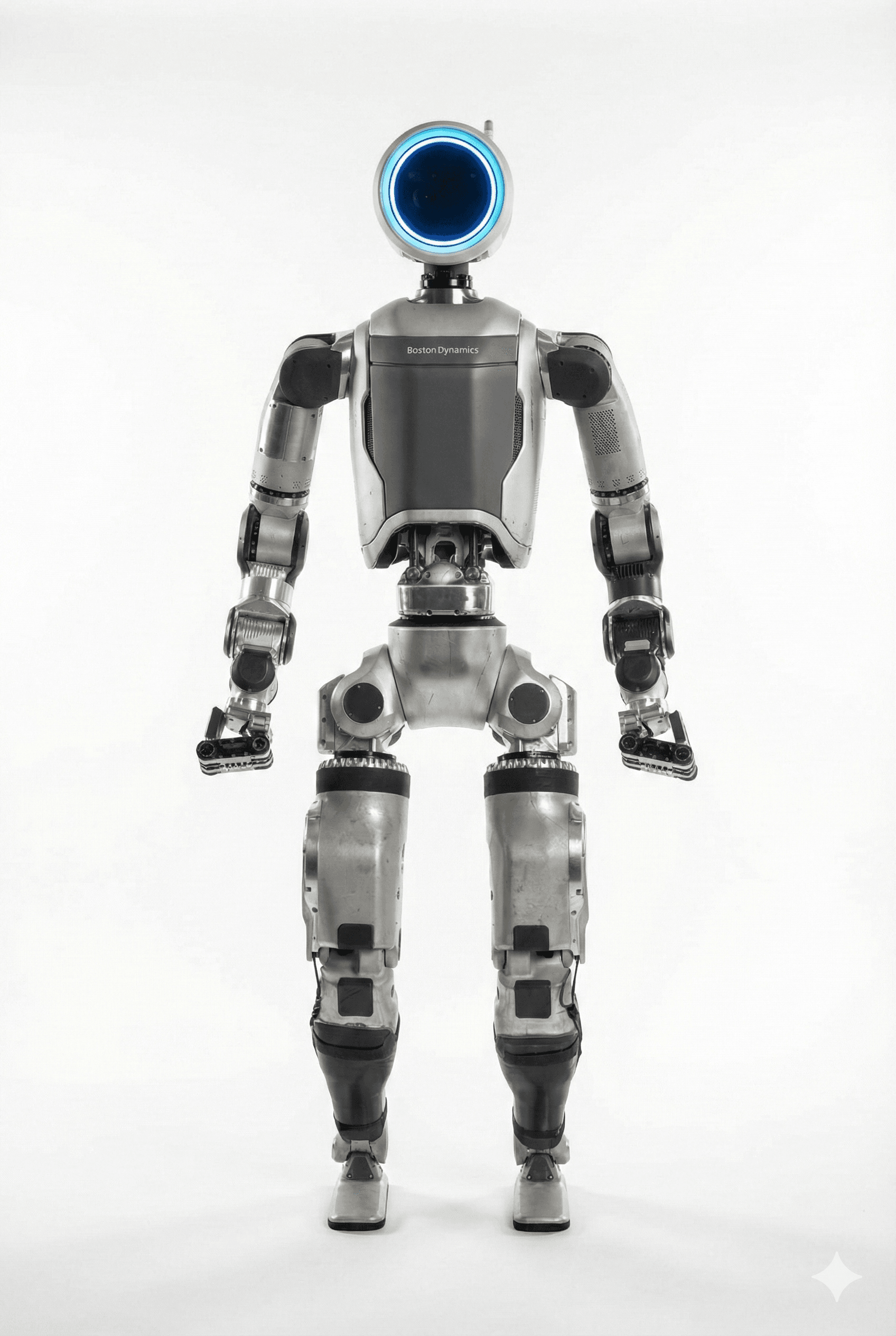
The shift towards using humanoid robots, particularly those featuring legs and the general human form factor, represents a pivotal and often debated direction in modern automation. In a recent webinar transcript from Boston Dynamics, experts explained the strategic rationale behind this commitment, detailing why the human shape is not merely a novelty, but an essential component for unlocking the future of flexible, general-purpose automation.
Leading the conversation were Ya Durban, who guides the Atlas product strategy and focuses on long-term customer needs, and Alberto Rodriguez, who directs the Atlas behavior team, responsible for the development and implementation of the robot's AI movement strategy. Their consensus is that the humanoid form is fundamentally about conquering variability and maximizing economic efficiency where traditional methods fail.
The Limits of Hard Automation and the Case for Generality
According to Rodriguez, even in highly efficient environments like modern factories, many tasks remain unautomated. This is often not due to a lack of technology, but rather an "economical reason". It simply "doesn't make sense to use current modern automation hard automation technologies to solve those tasks".
The central issue is variability. Rodriguez gave the example of a car manufacturing plant, which might assemble five to ten different cars, each having thousands of parts, five different trims, and twenty different colors. When you multiply these factors, the resulting "ton of variability" makes specialized, fixed-function machinery ("hard automation") economically unfeasible.
The "real value [of humanoids], it's addressing directly that variability that generality that can unlock the ceiling of current automation techniques," Rodriguez asserts.
Durban notes that customers are excited about a machine that is "flexible and that is adaptable to real life environments". If the long-term vision is for a robot to be easily retasked and "do anything in a building that a human might do," then the hardware must be built to function in those environments. Atlas is aiming for incredibly complex maneuvers, such as a human bracing with one hand while fishing for a bolt with the other, inserting it into a driver, and screwing it onto the underside of a car—tasks Rodriguez identifies as their "lighthouse".
The human form factor allows Boston Dynamics to focus their research and development on a single platform. Durban explains that this approach allows them to avoid the cost and complexity of having to "keep building a new robot every time we want to explore a new application or a new opportunity," thereby reducing the cost of iteration.
The Justification for Legs
The decision to incorporate legs, adding apparent complexity compared to wheels, has been a key internal debate that the team now feels "very confident" about.
Rodriguez clarifies that the historic technological bottleneck associated with legs—dynamic stability, or keeping the robot from falling—has become an "easy problem today". Legs offer several key capabilities:
- Slimmer Body: This allows the robot to enter "more constrained environments" common in many factories.
- Faster Turning: Legs allow for quick turns by enabling discrete contact changes, while wheeled systems must navigate the dynamics of stopping and turning.
Interestingly, the engineering team finds that the economic argument against legs is weak. Rodriguez notes that from an engineering perspective, there is not "much of an advantage from an economical perspective in having a wheelbased robot". A mobile base that is stable and omnidirectional requires a similar number of actuators as a legged system, and may even have higher mass, requiring higher power. Rodriguez suggests that building legs "might actually be the case that building legs ends up being cheaper than building stable high performance mobile platforms" that can reach the same high and low areas humans can.
One remaining caution, however, is safety. Rodriguez points out that the process to certify the safety of a dynamically balancing robot in a human environment "is still today something that we don't know how to do," although the company is working with others to establish the necessary regulations and certificates.
The AI Brain and Scaling Behavior
Achieving the high degree of generality promised by the humanoid form relies heavily on new software and AI techniques. Rodriguez explains that the traditional approach to creating robot behavior (a "pyramid" of algorithms that distill raw inputs into concrete actions) struggles with maintenance and scalability.
Today, the approach replaces that layered structure with a system that is "taught to do the thing that you want it to do through experience". This "AI brain," which is the LLM equivalent in robotics, has two crucial parts:
- Pre-training: The massive system that accumulates knowledge, capable of providing "common sense and generalization" (a good initial guess) for any task.
- Post-training: The necessary "on-the-job training" required to get the behavior to the extremely high reliability level needed by customers. This typically involves demonstration, often through teleoperation, where an experienced demonstrator uses a VR headset to see through Atlas's eyes and trackers on their body to control the robot in real-time, collecting 5 to 10 hours of demonstrations for a single behavior.
The key to scaling is the "flywheel" effect: reducing the time spent on post-training (the expensive, task-specific effort) by continually improving the pre-training (the general knowledge base).
Product Maturity and the Road Ahead
To prove the value of humanoids and secure continued investment, Durban stresses that they must hit milestones demonstrating that humanoids "can provide value today". Boston Dynamics uses the experience from Spot and Stretch deployments to map out the maturity process, moving from Phase One (hardware reliability challenges) to Phase Two (learning customer requirements and refining software) to Phase Three (scaling deployments, where Spot is today).
They selected industrial manufacturing as their initial "beachhead" because it offers the necessary scale, allows for an easier ramp-up of safety requirements in a structured environment, and provides sufficient variability to motivate the generality of the robot. If a robot can solve the complex manipulation tasks necessary to assemble a car, it is "good to go" for many other tasks—a concept Rodriguez calls "manipulation complete".
The vision is clear: "thousands of robots deployed... in the next 5 to 10 years". While customers cannot currently call a salesperson and buy an Atlas—early adopters like Hyundai are entering into a "partnership to launch a product"—the research and technological building blocks are in place to achieve this goal. The focus remains on tackling complex tasks that are ergonomically unfriendly for humans, proving that the flexible, human form factor is the indispensable solution for the next era of automation.
This article summarizes excerpts from the transcript of the video "Why Humanoids Are the Future of Manufacturing | Boston Dynamics Webinar," recently uploaded on the Boston Dynamics YouTube channel.