History
Boston Dynamics' three-decade journey from academic spin-off to commercial robotics leader reflects the broader evolution of the entire dynamic robotics field.
-
1992: Boston Dynamics founded by Marc Raibert as a spin-off from MIT's Leg Laboratory, initially operating as a DARPA-funded research contractor focused on dynamic balance and locomotion.
-
2000s: Developed iconic DARPA-funded projects including BigDog (gas-powered pack-carrying quadruped) and early Atlas prototypes, establishing global reputation for cutting-edge dynamic robots.
-
December 2013: Acquired by Google (later Alphabet) as part of Andy Rubin's robotics initiative, becoming one of eight robotics companies purchased to form Google's "Replicant" division.
-
2016: Cultural friction emerges at Alphabet over lack of near-term commercial products and public relations concerns about "terrifying" robot videos; company put up for sale.
-
June 2017: SoftBank Group acquires Boston Dynamics, marking the beginning of the commercialization era under Masayoshi Son's vision for smart machines.
-
2019: Launches Early Adopter Program, leasing over 150 Spot robots to select customers to gather real-world validation data.
-
June 16, 2020: Spot becomes commercially available for purchase—the first time in company history that customers can buy a Boston Dynamics robot. Partners with Kimball Electronics for contract manufacturing to achieve production scale.
-
December 2020: Hyundai Motor Group agrees to acquire 80% controlling stake, signaling strategic shift toward industrial manufacturing integration.
-
June 2021: Hyundai acquisition completed, valuing Boston Dynamics at $1.1 billion. SoftBank retains 20% stake. Integration with Hyundai's automotive supply chains and logistics operations begins.
-
March 2022: Stretch warehouse robot launches commercially, achieving immediate market demand and selling out inventory through 2024.
-
April 16, 2024: Hydraulic Atlas officially retired after over a decade of pioneering dynamic humanoid capabilities.
-
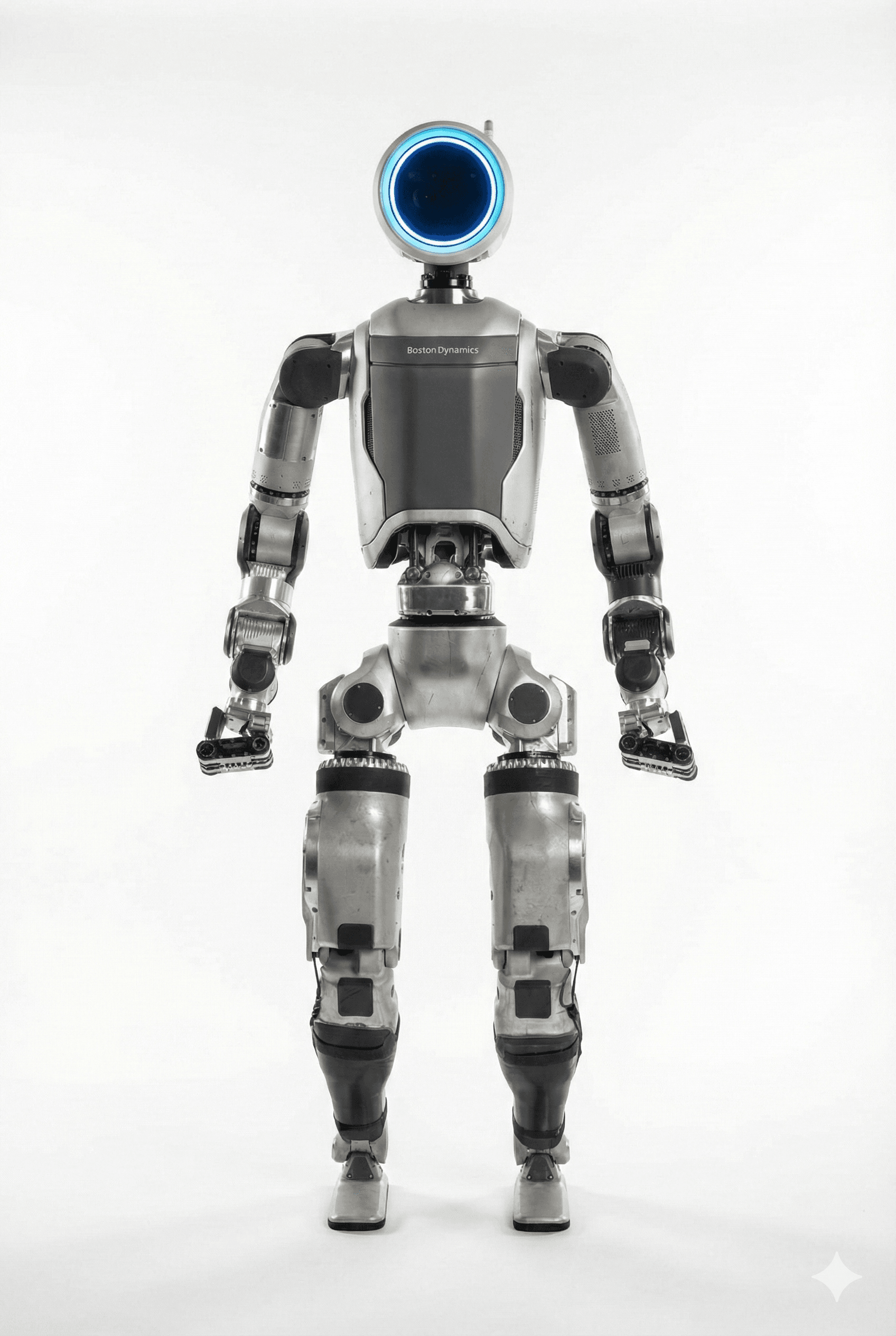
April 17, 2024: Electric Atlas unveiled one day after hydraulic retirement, featuring all-electric actuation, 360-degree joints, and AI-native design for commercial manufacturing deployment.
-
October 2024: Announces research partnership with Toyota Research Institute to apply Large Behavior Models to Atlas for advanced manipulation capabilities.
-
December 2024: Implements workforce rationalization, laying off approximately 45 employees (5% of workforce) to support sustainable growth and path to profitability.
-
February 2025: Formalizes partnership with Boston Dynamics AI Institute (founded by Marc Raibert) to create shared Reinforcement Learning training pipeline for electric Atlas.
The Hyundai Integration: Building the Robotics Value Chain
The Hyundai Motor Group acquisition is the linchpin of Boston Dynamics' transition from impressive prototypes to scalable industrial products. Unlike previous owners Google (a software company) and SoftBank (an investment firm), Hyundai brings tangible manufacturing and logistics infrastructure.
Strategic Synergies:
-
Supply Chain Power: Hyundai's massive global purchasing volume for motors, batteries, sensors, and precision components likely reduces Boston Dynamics' Bill of Materials costs significantly, improving unit economics.
-
Manufacturing Expertise: Access to Hyundai's production engineering knowledge enables Boston Dynamics to design robots for mass manufacturing from the start, rather than hand-building prototypes.
-
Captive Testing Ground: Hyundai's automotive factories worldwide serve as ideal pilot environments for Atlas. If the robot succeeds in handling automotive parts, welding inspection, and material transport in Hyundai plants, it's validated for the broader manufacturing industry.
-
Internal Customer: Hyundai Glovis (Hyundai's logistics subsidiary) provides immediate demand for Spot and Stretch robots, creating guaranteed revenue while proving use cases for external customers.
Vision: "Smart Mobility Solution Provider"
Hyundai views robotics as a pillar of its transformation beyond traditional automotive manufacturing. The company's stated goal is to create a complete "robotics value chain" integrating humanoid and mobile robots, autonomous vehicles, Urban Air Mobility, and smart logistics.
Manufacturing Excellence and Partnerships
Boston Dynamics' transition to commercial manufacturing required fundamental operational changes. To scale Spot production from dozens of research units to thousands of commercial robots, Boston Dynamics partnered with Kimball Electronics, a global electronics contract manufacturer. This partnership provides access to established supply chains, ISO-certified quality control, manufacturing capacity without massive capital expenditure, and expertise in high-precision assembly of complex mechatronic systems.
AI and Research Ecosystem
Boston Dynamics is building a collaborative research network to solve the hardest challenges in robotics cognition. The Toyota Research Institute partnership (October 2024) combines Atlas hardware with TRI's Large Behavior Models to teach robots complex manipulation through human demonstration. The Boston Dynamics AI Institute partnership (February 2025) creates a shared Reinforcement Learning training pipeline, ensuring cutting-edge theoretical work flows directly into commercial hardware development.
Ethics and Safety Leadership
Beyond the anti-weaponization stance, Boston Dynamics has designed comprehensive safety into its platforms. Spot features 360-degree obstacle avoidance, real-time path planning to navigate around people, collision detection, and configurable safety zones. The company explicitly positions Spot as an industrial tool, not a consumer product, and works with customers to ensure proper training and compliance with workplace safety regulations.