History
The electric Atlas emerges from over a decade of pioneering research in dynamic humanoid robotics:
-
July 2013: Original hydraulic Atlas debuts for DARPA Robotics Challenge, designed for disaster response scenarios inspired by Fukushima nuclear accident. Stands 1.8m tall, weighs 150 kg, features 28 degrees of freedom.
-
2016: "HD Atlas" becomes battery-powered and untethered, demonstrating parkour, backflips, and gymnastics that capture global imagination and establish Boston Dynamics as leader in dynamic robotics.
-
2013-2024: Hydraulic Atlas evolves through multiple iterations, validating Model Predictive Control algorithms and whole-body coordination but remaining too loud, maintenance-intensive, and energy-inefficient for commercial deployment.
-
April 16, 2024: Hydraulic Atlas officially retired after over a decade of groundbreaking research, concluding the era of pure research demonstrations.
-
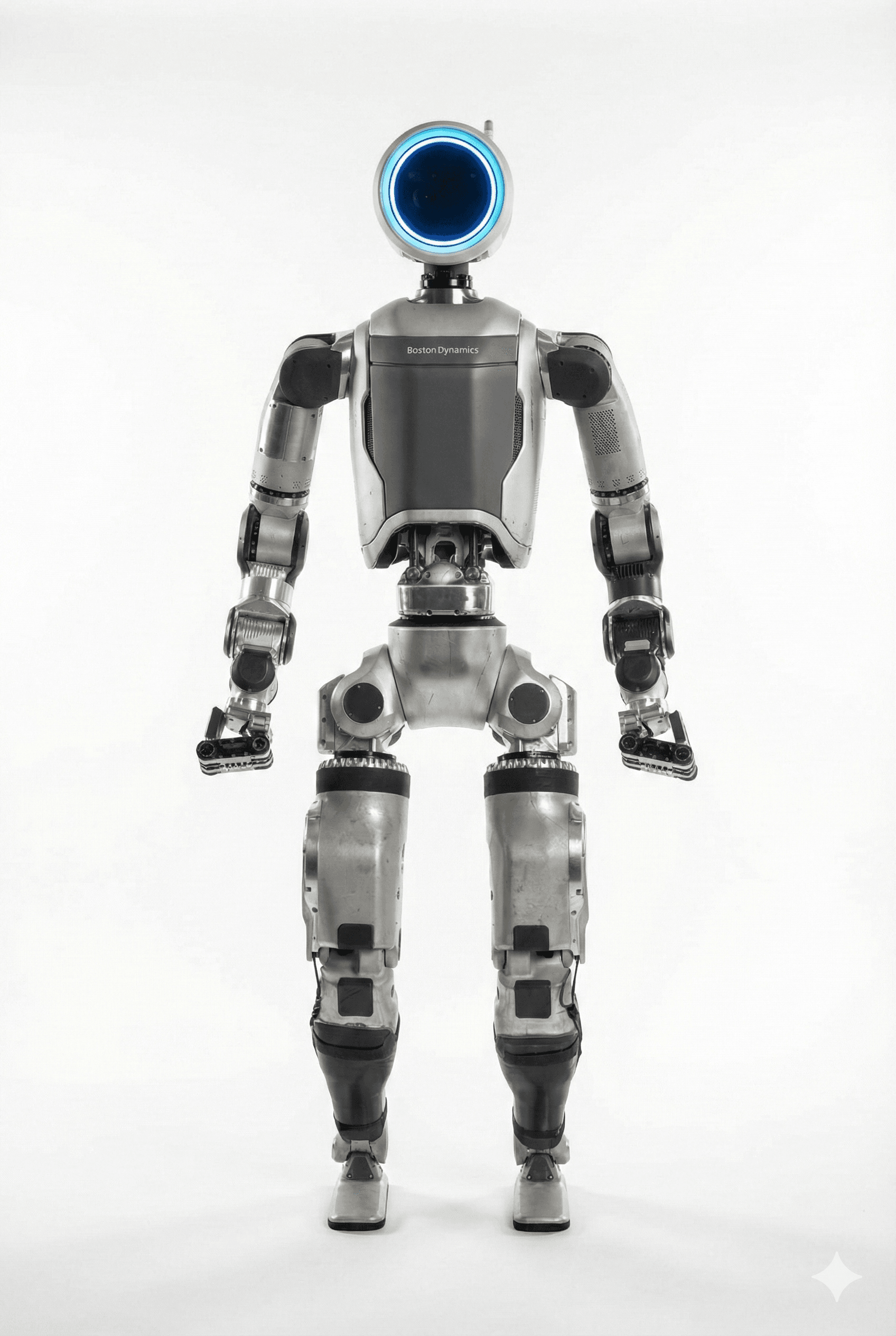
April 17, 2024: Electric Atlas unveiled as clean-sheet redesign featuring all-electric actuation, 360-degree joints, slimmer profile, 3D-printed titanium/aluminum construction, and AI-native architecture.
-
October 2024: Partnership with Toyota Research Institute announced to integrate Large Behavior Models for advanced manipulation learning through diffusion policies and learning from demonstration.
-
November 2024: NVIDIA collaboration expanded, confirming Atlas designed for Jetson Thor computing platform and Isaac Lab simulation training.
-
2024-Present: Pilot deployments at Hyundai Motor Group facilities ongoing, with robots performing autonomous part sequencing in automotive manufacturing and generating training data for continuous AI improvement.
Design Philosophy: Super-Human Efficiency Over Biomimicry
Unlike most humanoid robots that attempt to replicate human form and function, Atlas is engineered to exceed human capabilities where it improves operational efficiency. This philosophy is most evident in the 360-degree rotating joints at hips, waist, and neck—movements impossible for biological systems but dramatically more efficient in constrained factory environments.
A human worker turning 180 degrees must shuffle feet, pivot torso, and reposition—a multi-second, multi-step process. Atlas simply rotates its torso instantly without moving its feet, reducing cycle time for repetitive tasks by seconds per iteration. Over thousands of daily cycles, this compounds into significant productivity gains.
The compact 1.5-meter stature similarly prioritizes function over human mimicry. The lower center of gravity improves stability during dynamic movements, while still providing sufficient reach for standard industrial workstations. The 89 kg mass—heavier than human average—reflects industrial-grade durability over lightweight consumer aesthetics.
From Hydraulics to Electric: A Technical Revolution
The retirement of the hydraulic Atlas on April 16, 2024, followed by the electric unveiling April 17, 2024, marked the most significant engineering transition in the program's history. This wasn't an upgrade—it was a complete architectural redesign driven by commercial necessity.
Hydraulic Legacy (2013-2024):
For over a decade, hydraulics enabled Atlas's most impressive capabilities. The hydraulic actuation system provided immense power density, allowing the robot to perform backflips, parkour, and dynamic leaps that captured global imagination. These weren't stunts but validation tests for Model Predictive Control algorithms—calculating precise torque at every joint to launch, rotate mid-air, and land with millisecond adjustments.
However, hydraulic systems had fundamental commercial limitations:
- Acoustic disruption: Constant hydraulic pump whine made factory coexistence with humans untenable
- Maintenance intensity: High-pressure fluid systems prone to leaks at every seal and connection
- Energy inefficiency: System pressure maintained constantly even when robot static, severely limiting battery life
Electric Revolution:
The shift to electric actuation eliminates these barriers. Custom high-torque electric motors provide on-demand power consumption—energy used only when torque applied, with regenerative braking recovering energy during deceleration. This dramatically extends runtime to industrial shift lengths (estimated 4-8 hours).
Reliability improves exponentially. No hoses to burst, no pumps to fail, no fluid contamination. Mean Time Between Failures (MTBF) jumps from research-prototype levels to industrial-robot standards required by automotive manufacturing.
The technology enabling this transition is recent advancement in high-flux magnets and motor winding geometries, closing the historical gap where hydraulics were the only option for high power density. The electric Atlas likely uses Quasi-Direct Drive (QDD) actuators—high-torque motors with low-ratio gearing (6:1 to 10:1) providing high back-drivability. Motors absorb impacts directly without gear damage, critical for robots operating in unpredictable real-world environments.
Advanced Materials and Manufacturing
The electric Atlas chassis utilizes 3D-printed titanium and aluminum components, representing the frontier of additive manufacturing for robotics. Generative design algorithms optimize structural topology, placing material only where load paths require it—creating organic, skeletal shapes that maximize strength-to-weight ratio.
This manufacturing approach enables:
- Complex geometries: Impossible to machine traditionally, optimized for stress distribution
- Rapid iteration: Design changes implemented quickly without retooling entire production lines
- Mass customization: Components tailored for specific deployment environments without economies-of-scale penalties
The custom battery pack integrated into the torso leverages learnings from Boston Dynamics' Spot platform (4+ years of commercial deployment data). While specific capacity remains undisclosed, the system likely supports rapid swapping or fast charging to minimize downtime in 24/7 manufacturing environments.
Cognitive Architecture: The Convergence of Control Theory and Generative AI
Atlas's intelligence represents a hybrid approach—fusing proven physics-based control with cutting-edge machine learning in what Boston Dynamics calls "Athletic Intelligence."
Reinforcement Learning Pipeline:
Engineers train neural networks in NVIDIA Isaac Lab physics simulators where virtual Atlas robots attempt tasks millions of times. Successful policies transfer to physical hardware through Sim-to-Real techniques. This enables:
- Whole-body control: Coordinating legs, torso, and arms simultaneously rather than controlling limbs independently
- Dynamic recovery: Learning to catch falls, adjust to shifting loads, and navigate unexpected obstacles
- Continuous improvement: Each real-world experience feeds back into training data, improving performance over deployment lifetime
Toyota Research Institute Partnership (Large Behavior Models):
The October 2024 TRI collaboration focuses on Large Behavior Models (LBMs)—generative AI for physical manipulation analogous to how LLMs generate text. Key innovations:
Diffusion Policies: Using the same diffusion models that power image generation (like DALL-E) to create smooth, robust motion plans for complex multi-step tasks. This allows Atlas to handle "long-horizon" tasks spanning minutes with dozens of sequential actions.
Learning from Demonstration: The ultimate goal is enabling Atlas to watch a human perform a novel task and replicate it autonomously, adapting to variables like different tool placements, lighting conditions, or part orientations. This moves beyond pre-programmed routines to genuine generalization.
Natural Language Understanding: Processing high-level commands ("move these engine parts to assembly station 3") and autonomously generating the low-level motor command sequences to achieve the goal—navigating obstacles, grasping varied parts, and placing precisely.
Vision System: From LIDAR to Camera-Centric Perception
The electric Atlas abandoned the spinning LIDAR unit that characterized the hydraulic version, embracing a vision-centric architecture that reduces cost, weight, and mechanical complexity while leveraging recent advances in computer vision.
"Ring Light" Head Design:
The circular housing contains arrays of RGB cameras and depth sensors (likely Time-of-Flight or stereo camera pairs) providing 360-degree environmental awareness. Visual SLAM (Simultaneous Localization and Mapping) algorithms build 3D maps using cameras alone, enabling navigation without expensive LIDAR.
Multi-Modal Sensing:
- Head cameras: Primary perception for navigation and environmental mapping
- Hand-mounted cameras: Close-range visual data when head cameras occluded by robot's own arms during manipulation
- Solid-state depth sensors: Likely retained in torso for redundancy on safety-critical obstacle avoidance
- Tactile sensing: Fingertip and palm sensors detect object properties, grip force, and slippage
This sensor fusion enables robust perception across diverse factory conditions—varying lighting, dust, dynamic obstacles (human workers, forklifts), and reflective surfaces.
Hyundai Integration: The Manufacturing Validation Ground
The Hyundai Motor Group acquisition provides Atlas with something no competitor possesses: a captive testing environment at automotive manufacturing scale.
Hyundai Metaplant America in Georgia serves as the primary validation facility:
- $21 billion total investment ($6B for innovation/R&D)
- Target production: 300,000-500,000 vehicles annually
- Atlas pilot deployment: Part sequencing operations moving automotive components from shipping containers to assembly line sequencing dollies
This real-world testing generates invaluable data:
- Failure mode identification: Understanding how robots break in demanding production environments
- AI training data: Thousands of part-handling cycles improve grasping and placement algorithms
- ROI validation: Quantifying labor cost savings, productivity gains, and uptime reliability
If Atlas succeeds in Hyundai's demanding automotive environment, it's validated for the broader manufacturing sector. Hyundai's stated intention to purchase "tens of thousands" of Boston Dynamics robots signals confidence in Atlas's commercial trajectory.
Strategic Synergies:
- Supply chain leverage: Hyundai's massive purchasing volume for motors, batteries, and sensors reduces Atlas Bill of Materials costs
- Manufacturing expertise: Access to production engineering knowledge enables design-for-manufacturability from the start
- Internal customer: Guaranteed demand provides revenue while proving use cases for external customers
- Global testing grounds: Hyundai facilities worldwide offer diverse deployment environments for validation
Orbit Fleet Management: The Nervous System
A single robot is a tool; a fleet is a system. Orbit™ serves as centralized command and control for Boston Dynamics' robotic workforce, managing Spot, Stretch, and Atlas from unified interface.
Capabilities:
- Mission planning: Schedule routine tasks (inspections, material transport) with waypoints and success criteria
- Remote operation: Human operators take control for edge cases AI cannot resolve
- Data aggregation: Collects performance metrics, anomaly detection, and facility health insights
- Digital twins: Creates virtual replicas of physical facilities using Spot-surveyed maps that Atlas uses for navigation
- Enterprise integration: APIs and webhooks connect robot data to ERP/EAM systems for real-time inventory updates
Privacy and Security:
- Automated face blurring protects worker privacy in collected imagery
- Encrypted communications secure robot-to-cloud data transmission
- Role-based access controls ensure only authorized personnel operate robots
This software infrastructure differentiates Atlas from competitors lacking mature fleet management—critical for large-scale industrial deployment.