History
Engineered Arts has evolved from a boutique mechanical theater company to a leader in social humanoid robotics over two decades.
- October 2004: Engineered Arts founded by Will Jackson in his garden shed in Falmouth, Cornwall, UK
- 2005: Created "Mechanical Theatre" project for the Eden Project in Cornwall, introducing RoboThespian Mark 1 with pneumatic actuators for theatrical performance
- 2010: After successful installation at Copernicus Science Centre in Warsaw, pivoted from museum exhibition design to focus solely on robot hardware and software development
- 2010–2018: RoboThespian became fixture in global institutions including Kennedy Space Center and National Museum of Science, Technology & Space in Israel. Robot starred in theatrical productions and hosted National Geographic documentary
- 2018: Introduced Mesmer line featuring hyper-realistic appearance using 3D photogrammetry and silicone skin, shifting from pneumatic to silent electric motors
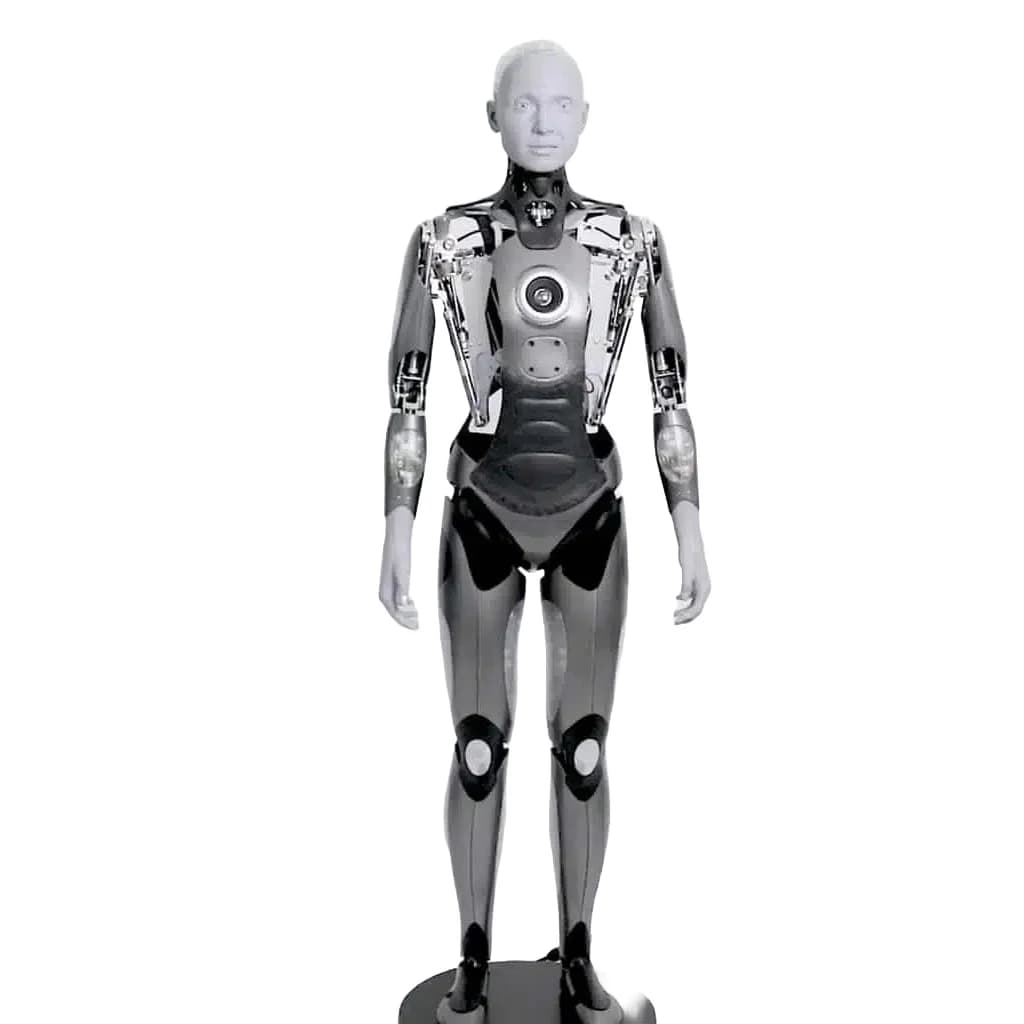
- February 2021: Commenced Ameca project, prioritizing human presence over hyper-realism
- December 2021: Ameca unveiled publicly, receiving viral attention for lifelike facial expressions
- January 2022: Ameca made physical debut at CES 2022 in Las Vegas
- 2022–2024: Integration of Large Language Models (GPT-3, GPT-4) transformed Ameca from pre-programmed performer to autonomous conversationalist
- 2024: Deployed over 250 robots in more than 30 countries, including installations at National Robotarium (Edinburgh) and Museum of the Future (Dubai)
- December 17, 2024: Restructured as U.S. corporation with headquarters in Redwood City, California, and raised $10 million Series A funding led by Helium-3 Ventures
"Animation First" Engineering Philosophy
Engineered Arts differentiates itself through a unique design methodology that reverses traditional robotics engineering.
Traditional robotics begins with mechanics: "Here is a servo, what range of motion does this give us?" This often results in robotic, jerky movement. Engineered Arts starts with the desired animation—the smile, the blink, the shrug—and then designs the mechanical systems to achieve that organic motion using Autodesk Inventor simulation.
The company employs a "Virtual Robot" tool within their Tritium software suite that allows animators (often with film or CGI backgrounds) to design movements in a digital environment. The software then translates these digital curves into motor commands, ensuring movements follow biological acceleration and deceleration curves of human muscles rather than linear servo ramps.
Result: When Ameca smiles, the movement is indistinguishable from human facial expressions, successfully bridging the uncanny valley through biomechanically accurate animation.
Tritium Operating System
The unifying technology across all Engineered Arts robots is Tritium, a browser-based operating system built on a Linux kernel.
Cloud-Native Architecture: Tritium can be operated from any laptop, tablet, or smartphone with a web browser—no specialized control station required. This democratizes access and simplifies deployment.
Tritium AI (The Brain Layer): Acts as middleware connecting robot sensors to cloud-based AI services, handling complex pipelines including:
- Speech-to-Text (STT) via Whisper or similar services
- LLM Processing through OpenAI GPT-4 or other models for response generation
- Text-to-Speech (TTS) via Amazon Polly
- Real-time Viseme Generation for lip-sync animation
Platform Approach: Like an app store, users can design and download "Roles" (personalities), positioning Engineered Arts as a platform provider where the physical robot delivers a vast library of digital personalities.
Product Portfolio
Ameca (Flagship): Full humanoid with 61 degrees of freedom, including 27 in the face alone. Features grey skin and exposed mechanics to avoid uncanny valley expectations. Equipped with binocular 8MP cameras, chest-mounted camera/Lidar, binaural microphones, and 4-channel microphone array. Height: 1870mm (73.6 in), Weight: 62 kg (137 lbs). Stationary platform (wheeled base or fixed plinth) prioritizing facial expression over locomotion.
Mesmer: Hyper-realistic humanoid using 3D photogrammetry to create digital twins of real humans. Features magnetic quick-release head system allowing operators to swap heads in minutes without tools, enabling one robot body to play multiple characters. Used for entertainment, IP representation, and historical figures in museums.
Desktop Series (Ameca Desktop, Ami, Azi): Bust-format robots retaining high-fidelity facial actuation (~32 DoF in head and neck) at accessible price points for academic research. Height: 550mm (21.7 in), Weight: 8.5 kg (17.6 lbs).
RoboThespian (Legacy): The company's original theatrical robot that established their reputation in museums and science centers globally from 2010-2018.
Strategic Partnerships
OpenAI: Integration of GPT-4 enables Ameca to serve as physical interface for conversational AI, generating novel responses based on conversation context. Multimodal capabilities demonstrated through vision-language integration allowing Ameca to draw and discuss its drawings.
Visage Technologies: Provides SDK for visual processing, powering face tracking, age/gender estimation, and emotion detection. Enables real-time feedback loop where Ameca adjusts demeanor based on human interlocutor's emotional state.
Market Position: Human-Centric vs Task-Centric
While competitors like Tesla (Optimus), Figure AI, and Agility Robotics focus on replacing human labor with KPIs of walking speed and payload capacity, Engineered Arts explicitly rejects this path.
Philosophy: Founder Will Jackson argues the industry is obsessed with bipedal locomotion—an unnecessary complexity for social robots. "Why does the robot have to be shaped like a human?" he asks, noting that for washing dishes, a dishwasher is superior.
Niche: Human-Centric robotics for roles where the human form itself is the utility—receptionists, museum guides, teachers, and companions. In these roles, the ability to walk is secondary to the ability to smile, make eye contact, and listen.