History
Fourier has evolved from a rehabilitation robotics startup into a leading general-purpose humanoid robot manufacturer over the course of a decade.
- 2015: Fourier founded in Shanghai by Alex Gu, focusing on rehabilitation robotics
- 2017: Launched Fourier X1 exoskeleton, China's first commercial exoskeleton
- 2018: Opened first international office in Singapore; Zen Koh joined as co-founder
- 2019: Initiated Humanoid Robot Project (GR series); launched EXOPS platform with National Instruments
- 2020: Launched RehabHub platform; acquired Zhuhai RHK Healthcare
- January 2022: Completed Series D funding (¥400 million / ~$62M) led by SoftBank Vision Fund II
- March 2022: Formed strategic alliance with MyndTec Inc. (Canada) for rehabilitation technology distribution
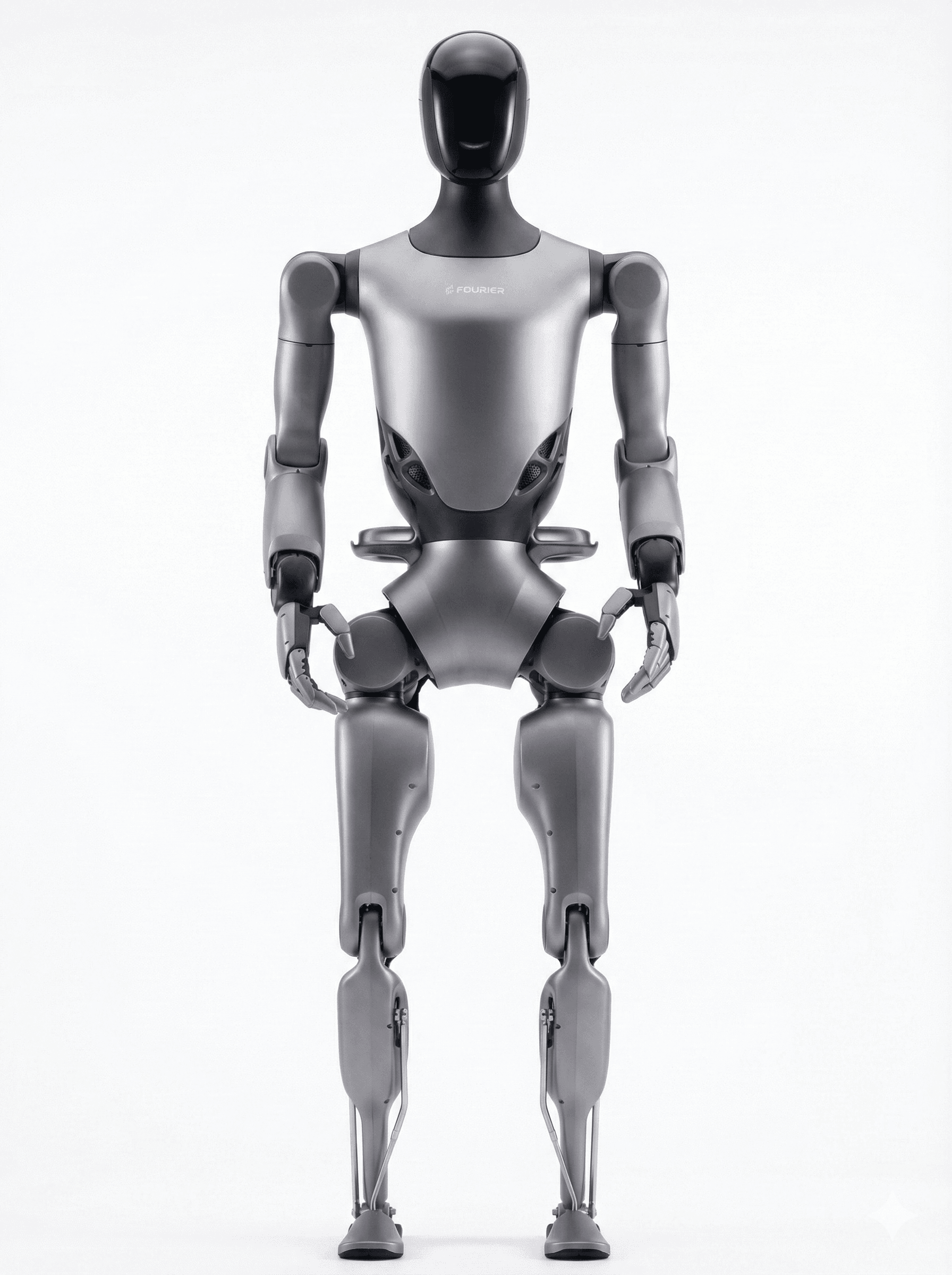
- July 2023: Unveiled GR-1 humanoid robot at World Artificial Intelligence Conference in Shanghai (1.65m tall, 55kg, 50kg payload capacity)
- Late 2023: Rebranded from "Fourier Intelligence" to simply "Fourier"; President Xi Jinping observed their humanoid robot during innovation tour; began limited GR-1 production
- 2024: Rehabilitation devices deployed in 2,000+ institutions across 40+ countries; GR-1 robots in pilot deployments at automotive factories
- September 2024: Unveiled GR-2 (1.75m, 63kg, 53 DoF, improved battery and dexterous hands)
- January 2025: Completed Series E funding round (¥800 million / ~$109M)
- August 2025: Launched GR-3 "care-bot" with LED facial features and tactile sensors; signed MoU with BASF for advanced materials development
- October 2025: Introduced N1 open-source humanoid with full design files released; launched FourierActionNet training database
Full-Stack Development Approach
Fourier differentiates itself through vertical integration, designing nearly all critical components in-house rather than relying on third-party suppliers. The company develops its own FSA (Fourier Smart Actuator) motors, which provide high torque density crucial for humanoid mobility and manipulation. The latest FSA 2.0 actuators deliver over 380 N·m of torque in a compact form factor. Fourier also builds its own control systems, sensor fusion algorithms, and AI software stacks. This full-stack approach gives Fourier greater control over performance, cost, and manufacturing scalability, though it requires significant R&D investment compared to companies that assemble robots from commercial off-the-shelf components.
Rehabilitation Robotics Foundation
Before entering the humanoid robot market, Fourier spent years building medical-grade rehabilitation devices including the X1 exoskeleton, RehabHub platform, and Motus therapy line. These products are deployed in over 2,000 hospitals, rehabilitation centers, and research institutions across 40+ countries. This experience gave Fourier deep expertise in human biomechanics, safety-critical robot design, regulatory compliance (FDA, CE marking), and long-term reliability. Many humanoid robot startups lack this real-world deployment experience. Fourier's medical robotics background informs their approach to humanoid design, particularly in areas like force control, safety protocols, and natural human-robot interaction.
AI and Embodied Intelligence
Fourier integrates ChatGPT-like multimodal large language models into its humanoid robots, enabling natural language interaction and contextual understanding. The robots combine vision data (from six cameras), language models, and physical control systems into what Fourier calls "embodied intelligence." The GR-3 features a dual-system AI architecture: a fast reflex system for immediate physical responses (grabbing a falling object, maintaining balance) and a deep reasoning system powered by LLMs for complex dialogue and task planning. Fourier supports industry-standard frameworks including ROS (Robot Operating System), NVIDIA Isaac SDK, and Mujoco simulation, making it easier for researchers and developers to build applications on Fourier platforms.
Open Platform Strategy
Fourier has embraced openness as a strategic differentiator. The company launched EXOPS (Exoskeleton & Robotics Open Platform) in 2019 in collaboration with National Instruments, providing developers with tools to build custom rehabilitation robotics applications. In October 2025, Fourier took this strategy further by releasing the N1 humanoid as fully open-source, including hardware CAD files, software source code, and assembly instructions. Fourier also released FourierActionNet, a large-scale database of robot actions and training data for AI model development. This openness aims to build a developer ecosystem around Fourier's platforms, accelerate innovation, and establish industry standards - similar to how Android's openness helped Google dominate mobile.
Manufacturing and Scale Ambitions
Fourier claims the GR-1 is the "world's first mass-produced humanoid robot" and has built manufacturing capacity targeting 5,000 units per year. However, actual production as of 2024-2025 remains in the hundreds of units, primarily for research labs and pilot deployments. The company is working to transition from prototype-scale production to true mass manufacturing. Fourier's manufacturing strategy emphasizes modularity, standardized components, and simplified assembly processes to reduce costs. The GR-3 features a modular design with hot-swappable batteries and cushioned exterior panels that can be easily replaced, signaling Fourier's focus on serviceability and total cost of ownership.