Gait
What is Gait in Humanoid Robotics?
The pattern of movement during locomotion.
Humanoid robots must develop stable gaits for walking, running, or climbing stairs. Different gaits optimize for speed, stability, or energy efficiency.
How Gait Works
Gait generation involves coordinating multiple joints to produce stable, efficient locomotion. The robot's control system defines a gait pattern - the sequence and timing of leg movements. For walking, this typically involves shifting weight onto one leg, lifting the other, swinging it forward, and placing it down before repeating with the opposite leg. The controller continuously monitors balance using IMU sensors and adjusts the gait in real-time to compensate for terrain irregularities or external disturbances. Advanced systems use central pattern generators (CPGs) - neural network models inspired by biological locomotion - that produce rhythmic movement patterns and can smoothly transition between different gaits.
Types of Gait
- Static Gait: Always maintains three points of contact for maximum stability, very slow
- Dynamic Walking: More natural human-like gait with single-foot support phases
- Running: Includes flight phase with no ground contact, requires sophisticated balance control
- Trotting: Diagonal leg pairs move together, stable at medium speeds
- Bounding: Both legs move in unison, useful for jumping
- Adaptive Gaits: Automatically adjust step length, height, and timing based on terrain and obstacles
Applications in Humanoid Robots
Different gaits enable humanoid robots to traverse various terrains and situations. Walking gaits are standard for indoor navigation on flat surfaces. Dynamic gaits allow faster movement in warehouses or outdoor spaces. Stair-climbing requires specialized gaits with higher leg lift and careful weight shifting. Running gaits enable rapid response in emergency or delivery scenarios. Energy-efficient gaits extend battery life during extended operations. Recovery gaits help robots regain balance after disturbances.
Example Humanoid Robots
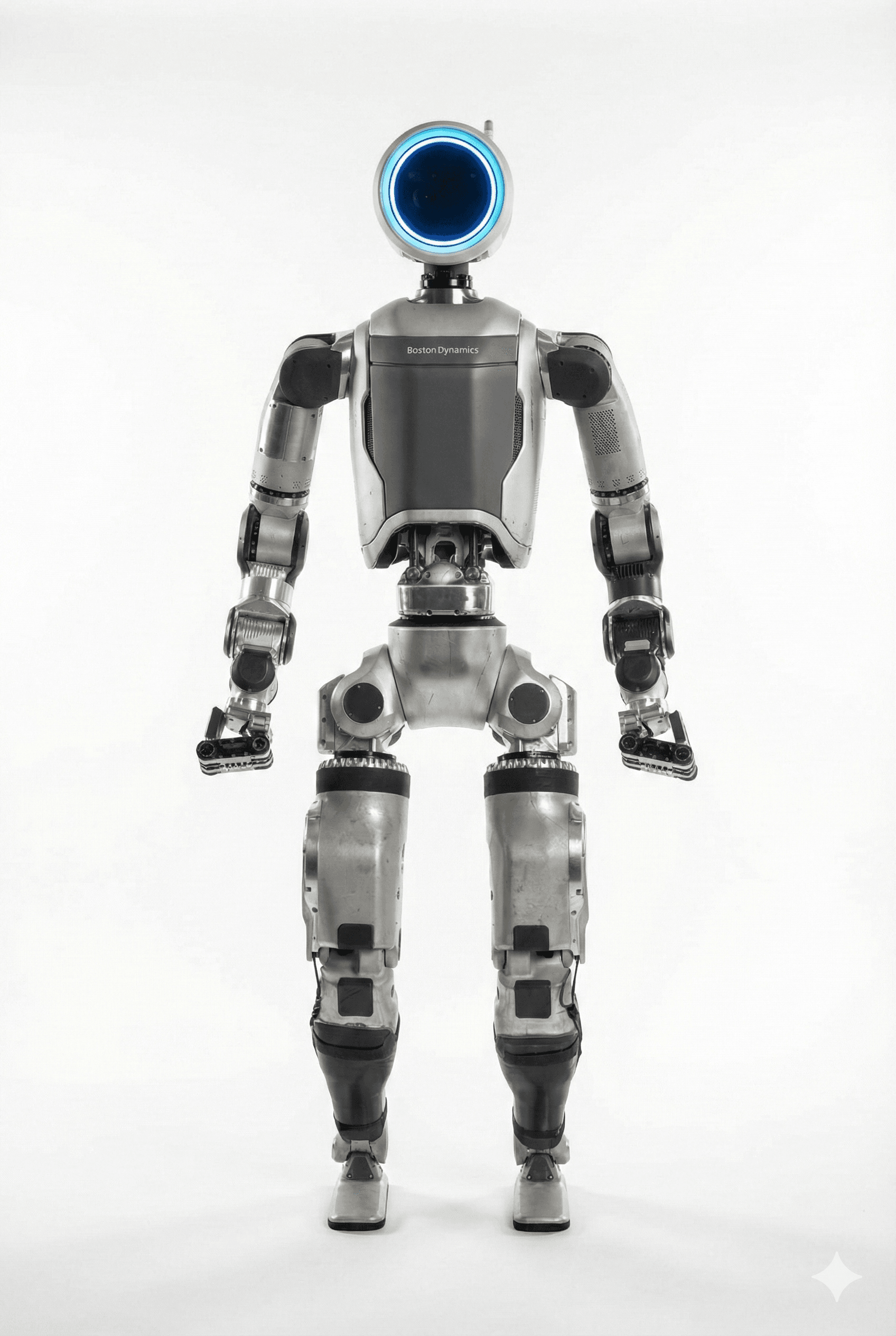
Boston Dynamics Atlas demonstrates multiple gaits including walking, running, and jumping with smooth transitions. Unitree H1 uses optimized walking gaits to achieve 3.3 m/s speed. Cassie by Agility Robotics showcases dynamic running and hopping gaits. Digit uses adaptive gaits to navigate uneven warehouse floors and outdoor terrain.